
Blog
Custom Acrylic Supplier Red Flags That Cost Importers Up to 35% More (Plus a 6-Point Audit)

Industry audits show that **31% of custom acrylic orders** from unvetted factories require rework, refunds, or re-sourcing within the first year. That failure rate quietly adds **$15,000–$50,000 per container** in chargebacks, shipping rework, and lost retail shelf windows. If you are sourcing a **custom acrylic supplier** for displays, stands, or branded fixtures, the gap between a 0.5mm-tolerance factory and an outsourcing broker is the gap between margin and write-off.
These eight pitfalls explain why some **custom acrylic manufacturing** projects land smoothly while others stall at inspection. More importantly, they show exactly how to filter for the factory structure, quality control, and communication habits that protect your landed cost.
## Pitfalls 1–3: Material and Tolerance Traps That Inflate Landed Cost
### Red Flag 1: Virgin vs. Recycled Acrylic — The 30% Price Gap Nobody Quotes
Some factories substitute recycled or regrind acrylic to win the unit-price war. Recycled sheet yellows within **12 months**, cracks at lower impact force, and shows uneven light transmission in LED displays. A reliable **custom acrylic supplier** always names the sheet brand and grade—Lucite, Mitsubishi, or equivalent—directly on the proforma invoice. If the quote only says “acrylic,” assume the worst.
### Red Flag 2: Loose Dimensional Tolerance on Cut and Bend
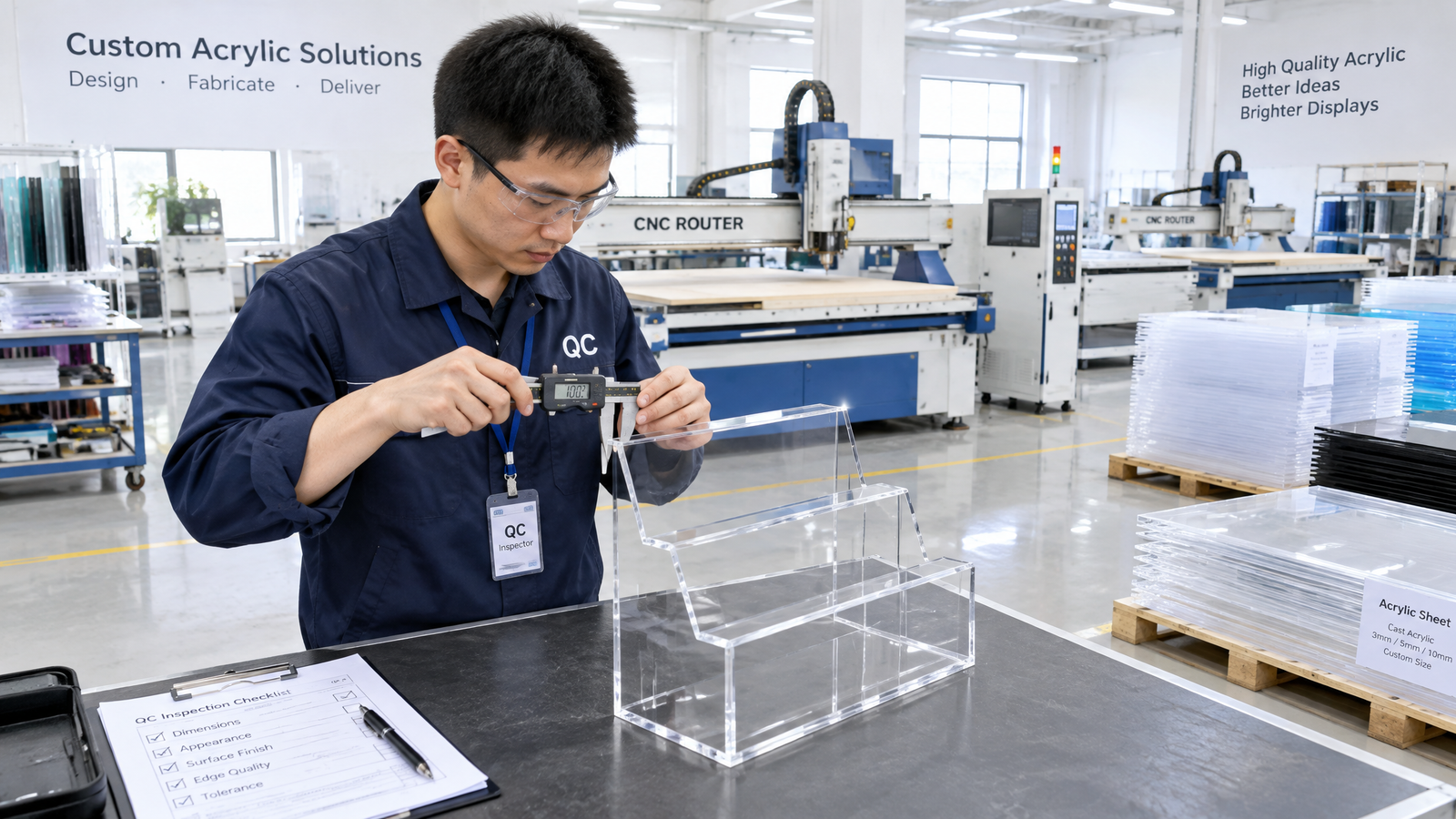
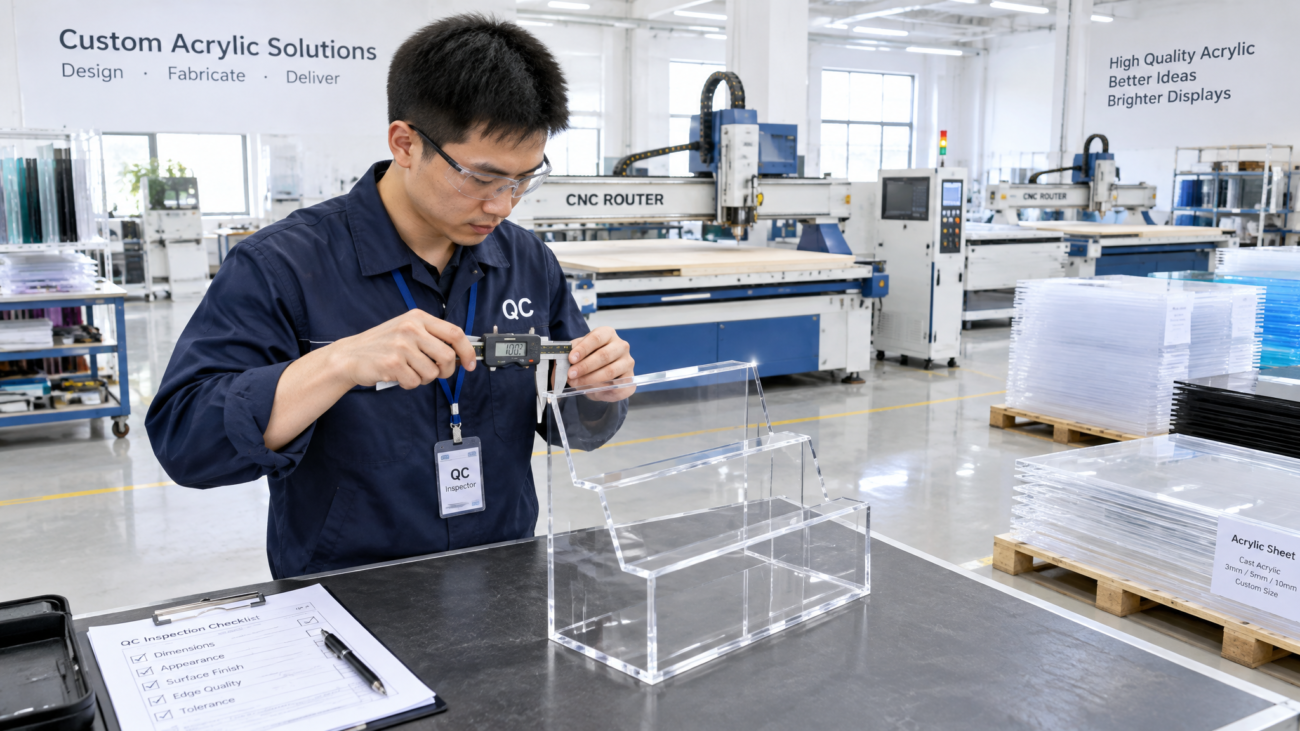
A low-cost laser-cutting setup drifts beyond **±0.5mm** on display joints and shelf notches. The result is visible seams, misaligned shelves, and retail rejects. Industry audits show that in-house QC teams can hold **±0.2mm on 5mm sheet** with calibrated calipers or CMM checks. Demand a tolerance report with every pre-production sample, not just a glossy photo.
### Red Flag 3: “Polished” Edges That Are Actually Flame-Dulled
Flame polishing hides stress marks but weakens edges and creates micro-cracks near drilled holes. For load-bearing acrylic parts and display hardware, specify **diamond-polished or CNC-routed edges** instead. Ask for edge close-up photos at 10x magnification before approving mass production. Cheap edge finishing is the most common invisible defect in **custom acrylic fabrication**.
## Pitfalls 4–6: Hidden Costs and MOQ Traps in Acrylic Sourcing
### Red Flag 4: The “Free Mold” That Costs $2,000 Later
For thermoformed or injection-molded acrylic components, some suppliers bury mold ownership in fine print. You pay the mold fee “upfront” but never receive the CAD files or the physical mold when you leave. Reliable **custom acrylic product factories** write mold ownership, handover terms, and IP rights into the contract before the first sample. No clause, no payment.
### Red Flag 5: MOQ Games That Lock You Into Dead Stock
A factory that pushes **5,000 pieces** when your test order is 500 is optimizing its own line, not your cash flow. Smart **custom acrylic manufacturing** partners scale from a **100-unit pilot run** to full production. Beware suppliers who quote only one tier and refuse partial shipments—they are often hiding cash-flow pressure or excess raw material.
### Red Flag 6: Quoted EXW Prices That Hide Packing and Crate Fees
Acrylic scratches and cracks in transit when packed with newspaper and single-wall cartons. A low EXW quote often balloons **8–12%** once “export packing,” corner protectors, and palletization appear on the final invoice. Demand an FOB or DDP quote with the packing spec listed line by line. Professional **acrylic display factories** treat export packing as an engineering step, not an afterthought.
## Pitfalls 7–8: Factory Structure and Communication Red Flags
### Red Flag 7: The Outsourcing Broker Posing as a Factory
Ask for a live video walkthrough with today’s newspaper or a dated PO in frame. If the supplier cannot show cutting, polishing, and assembly under one roof, they are trading, not manufacturing. Outsourced **custom acrylic** orders typically run **15–25% higher defect rates** because no single team owns tolerance control from start to finish.
### Red Flag 8: One-Way Communication and Vague Sampling Timelines
If your contact needs **48+ hours** to answer a tolerance question or cannot return DFM feedback within three days, production communication is already broken. Reliable **custom acrylic suppliers** assign one dedicated project engineer and share a weekly QC report with photos and measurement data. Transparent, one-on-one communication is not a bonus—it is the early-warning system that prevents expensive surprises.
## How to Vet a Reliable Custom Acrylic Factory: A 6-Point Audit
Run this audit before you sign the next PO. Each step is designed to surface the eight red flags above within days, not months.
### Step 1: Verify Factory Registration and Export License
Check the business license, export registration, and any ISO 9001 or equivalent quality certification. Cross-reference the legal name with the bank account on the invoice. A real **custom acrylic** factory has nothing to hide here.
### Step 2: Request a Live Video Tour of All Processes
Ask for a walkthrough of cutting, edge polishing, bending, bonding, and assembly—preferably in one continuous video. Confirm whether the factory owns all processes in-house. Self-owned, full-process **acrylic fabrication** is the strongest defense against outsourcing defects.
### Step 3: Order a Paid Sample with a Tolerance Report
Never skip the paid sample. Request a dimensional inspection report with measured values for every critical feature. Compare the sample against your drawing and against the quoted tolerance. The sample report tells you more than ten sales calls.
### Step 4: Confirm Material Brand, Grade, and Thickness on the PI
Write the sheet brand, grade, and nominal thickness into the proforma invoice. Specify virgin material and reject regrind. This single line item prevents the most common material substitution in **custom acrylic manufacturing**.
### Step 5: Define QC Gates: Incoming, In-Process, and Final Inspection
Agree on inspection points before production starts: incoming sheet inspection, in-process checks after cutting and polishing, and a final AQL inspection before packing. Reliable **custom acrylic suppliers** will share this QC plan without being asked.
### Step 6: Lock Mold Ownership, IP, and Packing Spec in the Contract
Put mold ownership, CAD file handover, IP rights, and packing specifications into the purchase contract. If the supplier resists contract-level detail, treat it as a red flag. Contract clarity is how professional buyers avoid chargebacks and dead-stock traps.
## Conclusion: Stop Overpaying for Acrylic Sourcing Mistakes
The three takeaways are simple. First, **material substitution and loose tolerance** cause the majority of rework and retail rejects. Second, **hidden mold, MOQ, and packing fees** can inflate your landed cost by **8–35%**. Third, a **self-owned custom acrylic factory** with full-process in-house production, strict QC, and one-on-one communication eliminates these risks before they reach your invoice.
Use the 6-point audit checklist to pressure-test your current **custom acrylic supplier**. If they fail any step—material brand on the PI, live video tour, tolerance report, or contract-level mold ownership—start the search again. Your next container is too expensive to leave to a broker.
—
## 📚 Related Resources
– Acrylic Display Manufacturing Process: From Sheet to Showroom → /acrylic-display-manufacturing-process
– Custom Acrylic MOQ Guide: How to Negotiate a Pilot Run → /custom-acrylic-moq-negotiation-guide
– Virgin vs. Recycled Acrylic: A Material Grade Comparison → /virgin-vs-recycled-acrylic-comparison
– Acrylic Export Packing Standards for Damage-Free Freight → /acrylic-export-packing-standards
—
## ❓ Frequently Asked Questions
**Q:** How do I verify a custom acrylic supplier actually owns a factory?
**A:** Request a live video walkthrough showing cutting, edge polishing, bending, bonding, and assembly under one roof, ideally with today’s newspaper or a dated PO in frame. A self-owned, full-process factory can show every step without outsourcing.
**Q:** What dimensional tolerance should I expect from a reliable custom acrylic manufacturer?
**A:** Expect **±0.2mm to ±0.5mm** depending on sheet thickness and feature type. Ask for a calibrated caliper or CMM tolerance report with every pre-production sample to confirm the factory actually holds its quoted tolerance.
**Q:** Why is my acrylic supplier’s EXW quote 10% cheaper than competing FOB quotes?
**A:** A low EXW quote often excludes export packing, corner protectors, and palletization. These fees can add **8–12%** later. Always demand an FOB or DDP quote with the packing specification listed line by line.
**Q:** What is a reasonable MOQ for a first custom acrylic order?
**A:** A flexible custom acrylic supplier should accept a **100–500 unit pilot run** before scaling to full production. If a factory insists on 5,000 pieces immediately and refuses partial shipments, treat it as a cash-flow red flag.
**Q:** How do I prevent material substitution in custom acrylic fabrication?
**A:** Write the sheet brand, grade, and nominal thickness directly into the proforma invoice and specify virgin material only. Ask for the material brand to be restated on the final inspection report.