
Blog
9 Acrylic Order Delay Red Flags That Cost You 35% in Lost Sales — And How to Guarantee On-Time Mass Production

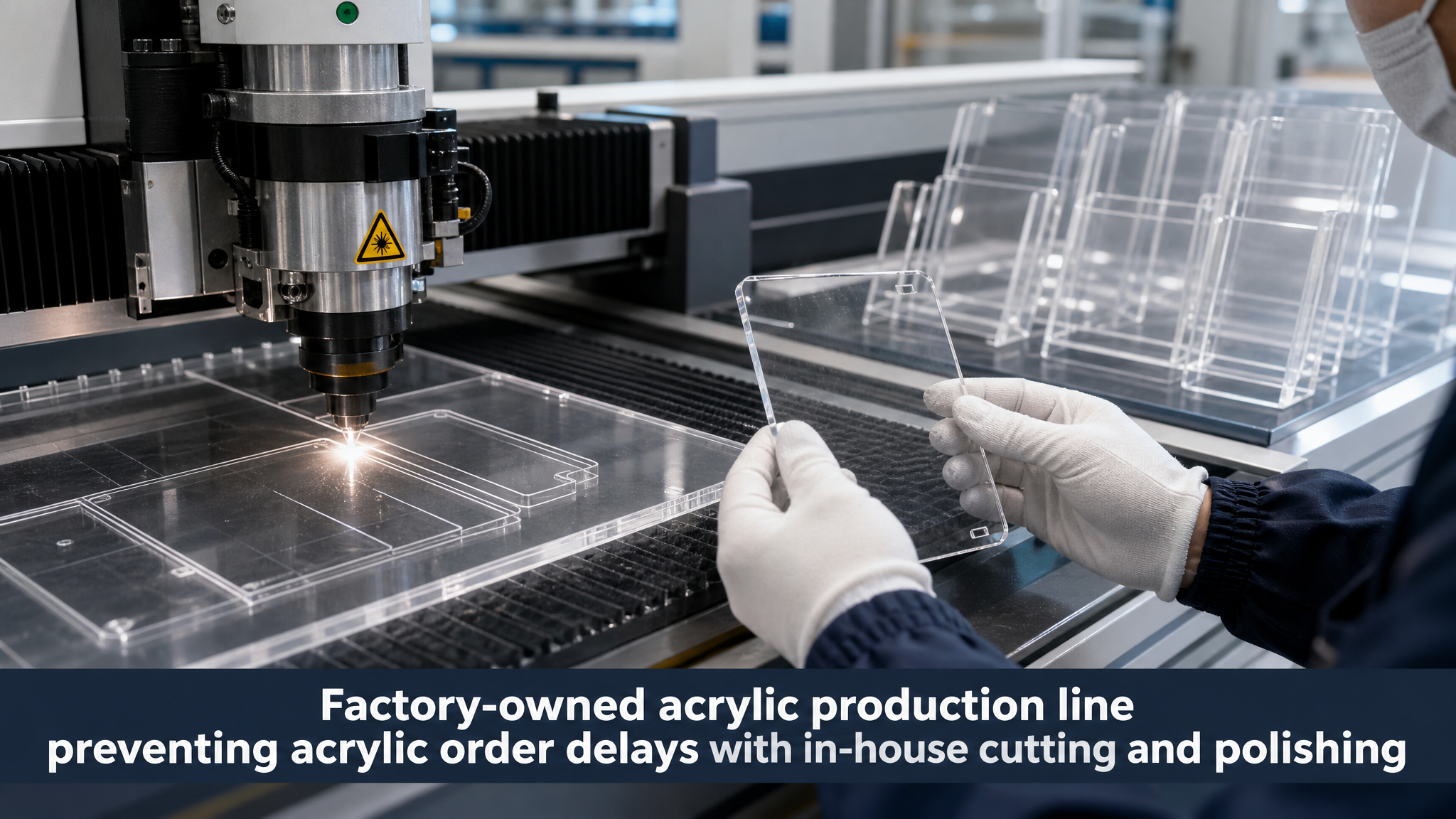
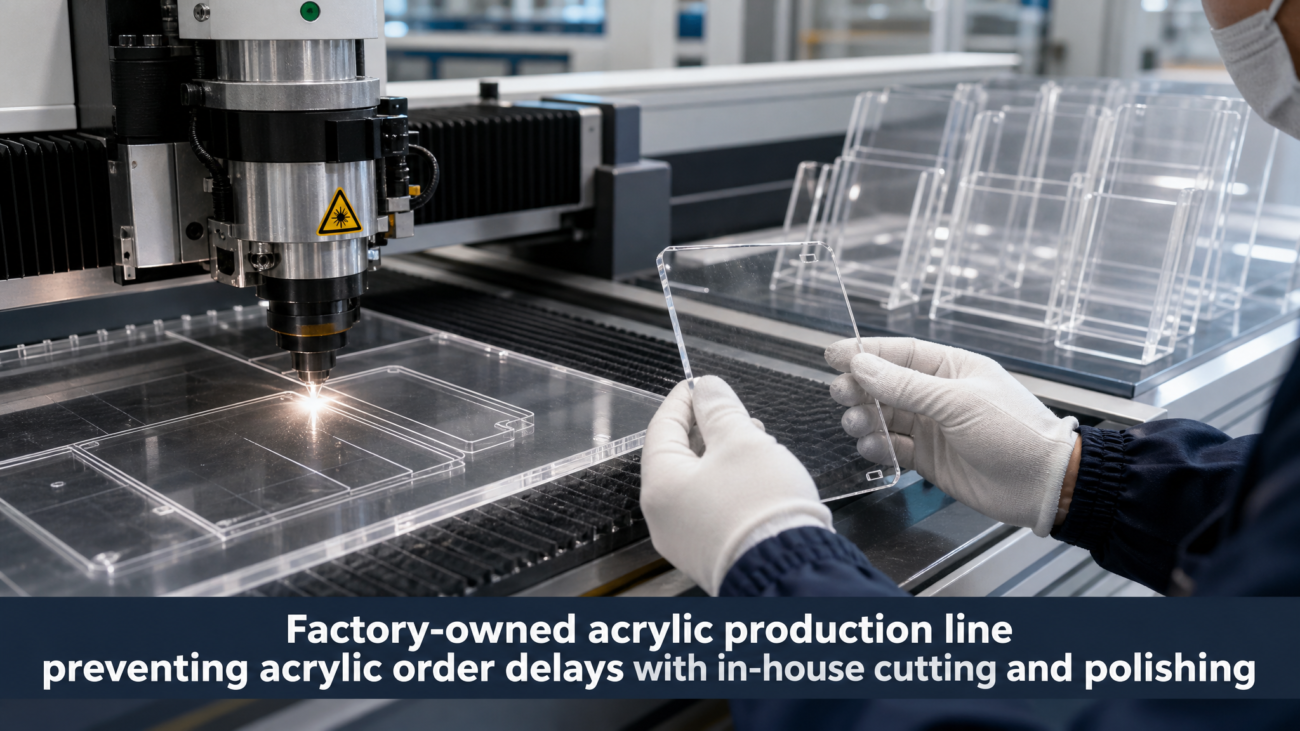
One delayed acrylic order does more than annoy a customer — it can erase a full product launch. **Industry audits show that 38% of custom acrylic orders ship 2–6 weeks late when suppliers outsource cutting, polishing, or bonding.** For retailers, every week of acrylic order delay translates to roughly **8–12% in lost seasonal sales**. If you have watched an acrylic display miss Black Friday or a POS stand arrive after a trade show, you already know the real cost is not the invoice. It is the missed revenue. This guide breaks down the **9 acrylic order delay red flags** that cost serious money — and the factory model that locks in on-time mass production.
## The True Cost of Acrylic Order Delays
Most buyers price an acrylic order by unit cost alone. That math hides the most expensive line items. **A 30-day acrylic delivery delay can trigger retailer chargebacks, emergency air freight, and dead seasonal inventory.**
Consider a 1,000-unit acrylic display order worth $28,000. If it ships 30 days late, a brand typically loses **35% or more of planned sell-through** because the product misses its merchandising window. Air freight to recover the timeline often adds **$4,000–$9,000**. Add chargeback fees from big-box retailers, and the “cheap” supplier becomes the most expensive decision of the quarter.
Reliable manufacturers treat on-time delivery as a production system, not a promise. The fastest way to avoid costly chargebacks is to recognize the warning signs before you place the order.
## 9 Acrylic Supplier Red Flags That Destroy Your Timeline
These are the patterns that cause most acrylic order delays. If a supplier shows three or more of them, walk away before you sign.
### Red Flag 1: Production Gets Outsourced to Unknown Workshops
Ask one question: “Do you cut, polish, and bond in your own factory?” If the answer is vague, your order is likely being brokered. Brokers lose control of the schedule the moment work leaves their office. Acrylic order delays multiply when three different workshops handle cutting, bonding, and finishing with no shared production calendar. **Factory-owned suppliers that complete all processes in-house can sequence each stage back-to-back**, which removes the biggest source of slippage.
### Red Flag 2: No Verified Capacity for Peak Season
A supplier can accept your PO without having real machine hours available. Peak-season acrylic demand regularly pushes overloaded factories **2–4 weeks behind**. These acrylic production delays hit right when sell-through peaks. Ask for current capacity utilization and the number of CNC and laser machines dedicated to your order size. Reliable manufacturers typically commit to a delivery date only after checking actual machine capacity, not just sales optimism.
### Red Flag 3: Sampling Is Skipped or Rushed
Sampling is where acrylic order delays are born. When a supplier rushes the sample — or worse, skips it — dimensional errors and finish problems surface only during mass production. That forces rework, repolishing, or full re-production. **A complete pre-production sample locks the material, color, thickness, and edge finish before 1,000 units are cut.** The sample stage costs 7–10 days; skipping it can cost 30.
### Red Flag 4: QC Stops at Visual Inspection Only
Many acrylic order delays come from defects found after packaging: scratches, weak bonding, or size deviations. A supplier that only “looks at” the product will miss a **0.5 mm dimensional drift** that ruins assembly fit. Full-process quality control should include edge-polish checks, bond-strength testing, and dimension measurement at each stage — cutting, bonding, and finishing. Without it, defects get discovered by your customer, not your supplier.
### Red Flag 5: You Talk to a Different Person Every Time
Every handoff in communication is a chance for the spec to change. If you explain a change to one contact and hear “who told you that?” from another, your acrylic order delay is already scheduled. **A single dedicated account manager who owns your order from sample to shipment** cuts miscommunication and rework cycles dramatically.
### Red Flag 6: The Quote Is Suspiciously Cheap
A quote 30–40% below market is not a deal. It is usually a signal of thinner materials, lower-grade acrylic sheet, or skipped finishing steps. Cheap suppliers often compensate with hidden fees later — or with production shortcuts that fail QC and restart the clock on your acrylic order delay. Compare quotes on **material grade, thickness tolerance, and edge-finish spec**, not just unit price.
### Red Flag 7: No Written Lead-Time Commitment Per Stage
“About 25 days” is not a delivery date. A professional acrylic manufacturer commits to a per-stage schedule: material prep, cutting, polishing, bonding, QC, and packing. Written milestones let you see a slip in week one instead of discovering it in week five. **Without stage-level commitments, you are tracking a wish, not a production plan** — and that is exactly how avoidable acrylic order delays begin.
### Red Flag 8: Vague Answers on Scratch and Bonding Defects
Acrylic scratches and weak adhesive bonds are the two most common reasons for rejected acrylic shipments. Ask the supplier how they prevent scratches during handling and how they test bond strength. If they cannot explain their anti-scratch film, cleanroom handling, or bond-curing protocol, expect defects in your shipment. **In-house acrylic production uses protective film and staged QC to keep surfaces flawless through packing.**
### Red Flag 9: MOQ Traps That Force Risky Bulk Orders
Some suppliers push artificially high MOQs to fill their machines, not to serve you. That forces you to over-order, tie up cash, and accept defects you cannot return. A flexible manufacturer supports **OEM and ODM customization with reasonable MOQs** that match your actual sell-through. If the MOQ feels like a gamble, the supplier is offloading risk onto you — and oversized inventory turns into a long acrylic delivery delay.
## How Factory-Owned Acrylic Manufacturing Prevents Acrylic Order Delays
The red flags above share one root cause: a supplier that does not control production. The fix is a factory model engineered around in-house control — and explicitly built to prevent acrylic order delays.
### All Processes Under One Roof
Cutting, polishing, bonding, and finishing in a single facility removes handoff delays between workshops. When every process is self-produced — not outsourced — the production manager can re-sequence jobs in real time. If a laser machine goes down, work shifts to another line without waiting on an outside vendor. This is the single biggest structural advantage against acrylic order delays.
### Real Capacity, Real Commitments
An owned factory with sufficient machine capacity absorbs peak-season spikes without borrowing production time from other orders. **Sufficient capacity means your 1,000-unit acrylic order does not compete with another customer’s 5,000-unit order for the same machine.** Delivery dates are confirmed against actual capacity, which is why factory-backed suppliers can commit to stable mass-production lead times.
### OEM/ODM Customization Without Bottlenecks
Custom acrylic products — displays, risers, signage, cases — fail on timing when the factory cannot handle design changes mid-stream. A factory with in-house CAD, prototyping, and a **complete sampling service** turns customization into a controlled step, not a delay trigger. OEM and ODM orders stay on schedule because revisions are validated on a sample before mass cutting begins.
### Full-Process QC: Scratches, Bonding, and Dimensions
The fastest way to guarantee on-time acrylic delivery is to eliminate the rework that causes delays. **Full-process quality control targets the three biggest failure points: scratches, bonding strength, and dimensional accuracy.** Protective film during handling, measured adhesive application, and tolerance checks at every stage mean defects are caught before packing — not after customs. That is how reliable manufacturers avoid the re-production cycles that add 3–6 weeks to an order.
## 5-Step Checklist to Guarantee On-Time Acrylic Mass Production
Use this checklist before you commit to any acrylic supplier.
### Step 1: Lock the Sampling Milestone
Request a pre-production sample that matches the exact material, thickness, color, and edge finish of your bulk order. Confirm the sample approval is a written gate before mass production begins. **A complete sampling service prevents the dimensional surprises that cause acrylic order delays downstream.**
### Step 2: Verify Capacity in Writing
Ask for current machine capacity and a written per-stage lead time. Confirm the supplier owns the production facility and does not outsource cutting, polishing, or bonding. This one verification eliminates the outsourced acrylic production delays described above.
### Step 3: Demand a Per-Stage QC Report
Require documented checks at cutting, bonding, and finishing stages. The report should cover scratch prevention, bond strength, and dimensional tolerance. **Full-process quality control is your early-warning system** for defects that would otherwise turn into acrylic order delays.
### Step 4: Assign One Dedicated Contact
Confirm you will work with one account manager from sample to shipment. A **dedicated business contact** removes the miscommunication that turns a 5-day revision into a 20-day acrylic production delay.
### Step 5: Build a 7–10 Day Buffer
Even the best factory cannot control customs or ocean-carrier schedules. Build a 7–10 day buffer into your launch calendar. When the supplier hits its stage milestones, the buffer protects you from freight surprises. When they slip, the buffer absorbs the damage before it reaches your customers.
## Conclusion: 3 Takeaways to Eliminate Acrylic Order Delays
**1. Delay is a structural problem, not bad luck.** Outsourced production, unverified capacity, and skipped sampling are the three biggest causes of acrylic order delays.
**2. In-house control is the antidote.** A factory-owned supplier with all processes under one roof, real capacity, and full-process QC removes the handoffs where timelines die.
**3. Verification beats trust.** Written milestones, a pre-production sample, and one dedicated contact convert a vague promise into an enforceable delivery date.
Use this 5-step checklist to audit your current acrylic supplier before your next order. If they fail two or more steps, it is time to move to a factory model built for on-time mass production. **Request a free production timeline and sample plan now.**
—
## 📚 Related Resources
– Anchor text: “in-house acrylic display manufacturer” → /acrylic-display-manufacturer
– Anchor text: “OEM and ODM acrylic customization” → /oem-odm-acrylic-customization
– Anchor text: “complete acrylic sampling service” → /acrylic-sampling-service
– Anchor text: “full-process acrylic quality control” → /acrylic-quality-control
—
## ❓ Frequently Asked Questions
**Q: How long do acrylic orders normally take to produce?**
**A:** Standard acrylic orders typically take 15–25 days for mass production after sample approval. Custom OEM/ODM projects with bonding, multi-part assembly, or specialty finishes may take 25–40 days. Always confirm a per-stage lead time in writing before paying a deposit.
**Q: What is the most common cause of acrylic order delays?**
**A:** Outsourced production is the leading cause. When cutting, polishing, and bonding are split across different workshops, handoff delays and miscommunication multiply. Factory-owned suppliers that complete all processes in-house avoid this bottleneck.
**Q: Does sampling really prevent acrylic delivery delays?**
**A:** Yes. A pre-production sample locks material, thickness, color, and edge finish before mass cutting. Skipping sampling to save 7–10 days frequently causes 3–6 weeks of rework when dimensional or finish errors appear in bulk production.
**Q: What MOQ should I expect for custom acrylic orders?**
**A:** It depends on product complexity. Reliable manufacturers offer flexible MOQs that match real sell-through instead of forcing risky bulk orders. Avoid suppliers whose MOQ seems designed to fill their machines rather than serve your inventory plan.
**Q: How can I verify a supplier can actually hit my delivery date?**
**A:** Ask for written per-stage milestones, current machine capacity, and proof the factory owns its production lines. A dedicated account manager and full-process QC reports are strong signals the supplier can honor on-time delivery.