
Blog
Retail Acrylic Display Trends for 2026 That Cost Late Adopters 18% in Lost Conversion

Retailers who ignore **2026 retail acrylic display market trends** are already losing up to **18% of in-store conversion** to competitors that refresh displays faster. Industry audits show the average store waits **14 months** between display updates, while top performers rotate acrylic merchandising displays every **6–8 weeks**. The cheapest acrylic display you buy this year is usually the most expensive long-term mistake.
This guide breaks down seven data-backed trends reshaping retail acrylic display products in 2026. We draw on development work for beauty, retail, digital, and exhibition clients across overseas markets — where trend adoption moves fastest. You will get a supplier audit checklist you can use before your next reorder.
## The Future of Retail Display: Why Acrylic Products Are the Next Big Opportunity in 2026
The global retail display market is projected to grow at a **5.8% CAGR through 2026**, with acrylic taking share from glass and metal. Acrylic display products now account for a significant slice of that growth because they are lighter, safer, and faster to produce. Industry audits show stores that align with 2026 acrylic display trends lift average basket size by **12–19%**.
Three forces are driving the shift. First, supply chain volatility has pushed retailers toward materials with shorter lead times. Second, beauty and consumer electronics brands demand transparent merchandising that photographs well for social media. Third, landlords and ESG programs now score in-store fixtures on recyclability.
### How to measure display ROI before you buy
– Track **dwell time** at the fixture, not just unit sales.
– Compare **cost per display change** across 12 months.
– Audit **replacement rate** for cracked or yellowed panels.
## Sustainable rPET and Mono-Material Acrylic Displays Are No Longer Optional
Recycled acrylic displays are moving from a nice-to-have to a tender requirement in 2026. rPET and recycled PMMA panels can cut a display’s carbon footprint by **30–50%** compared to virgin material. Major beauty and electronics retailers now ask for material certification before approving any new acrylic merchandising display.
Reliable manufacturers typically document the recycled content percentage on the quote. If a supplier cannot name the resin source, walk away. Mono-material construction — where the tray, body, and connector are the same acrylic grade — makes end-of-life recycling far easier.
### How to verify a recycled acrylic claim
– Request **rPET or R-PMMA certification** from the resin supplier.
– Ask for a **material composition sheet** with exact percentages.
– Confirm the display uses **mono-material acrylic** wherever possible.
– Check whether the supplier offers a **take-back or regrind program**.
## Modular and Reconfigurable Acrylic Display Systems Cut Cost Per Change by Up to 40%
Static displays are becoming a liability. Modular acrylic display systems with interchangeable trays, risers, and shelf dividers cut cost per display change by up to **40%**. Retailers can reconfigure a merchandising wall in minutes instead of ordering a brand-new fixture.
This matters because 2026 retail acrylic display market trends favor rapid assortment rotation. A beauty brand launching a new serum shade does not want to buy a new counter unit. Modular acrylic display products let the same base frame carry new product cards, signage, and tray layouts.
### How to spec a modular acrylic system
– Choose **tool-less assembly** to reduce store labor time.
– Standardize **shelf pitch** across SKUs for reusability.
– Specify **replaceable printed inserts** rather than glued graphics.
– Confirm the supplier keeps **interchangeable parts in stock**.
## Embedded Lighting and NFC Turn Acrylic Displays into Conversion Tools
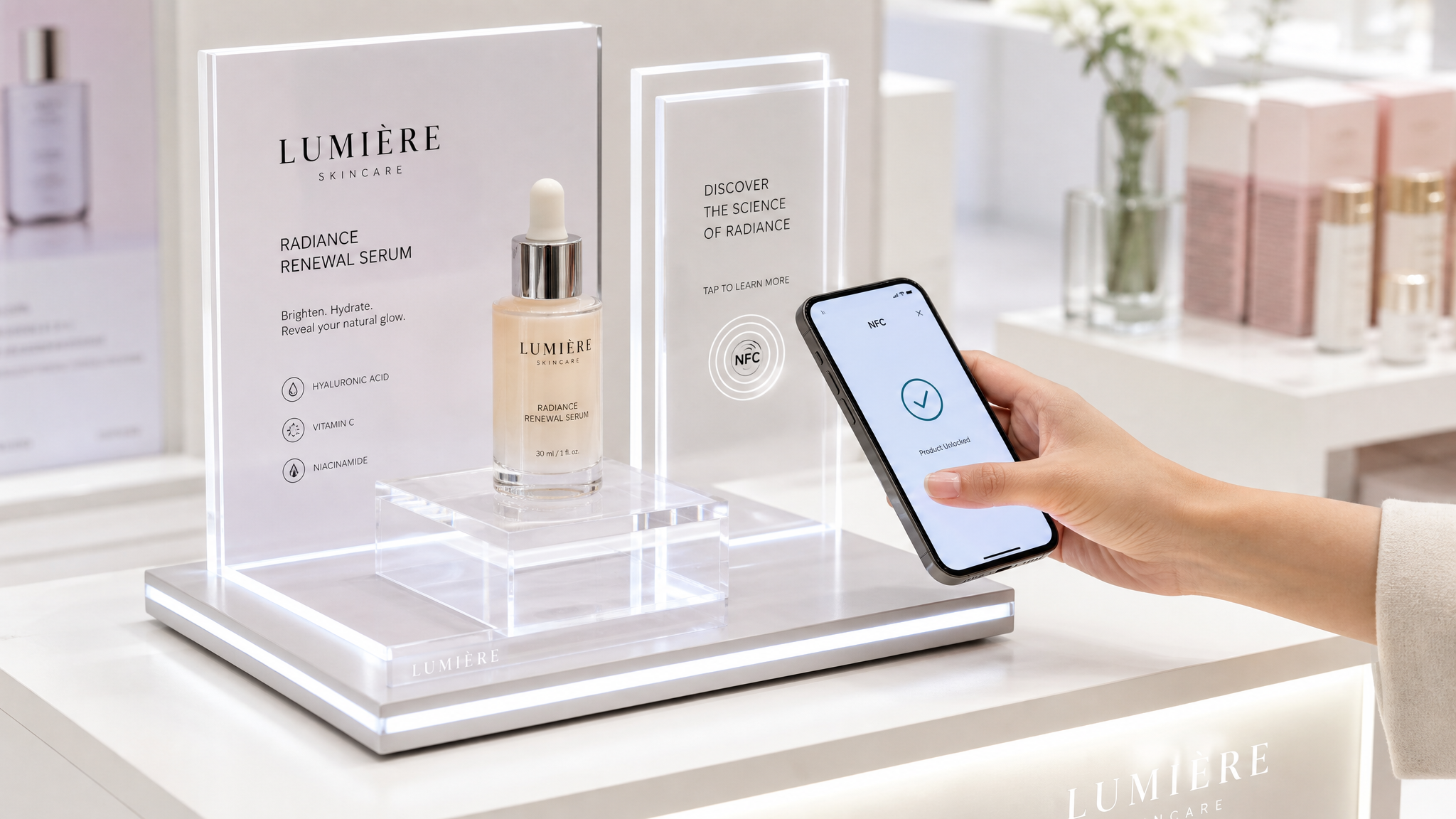
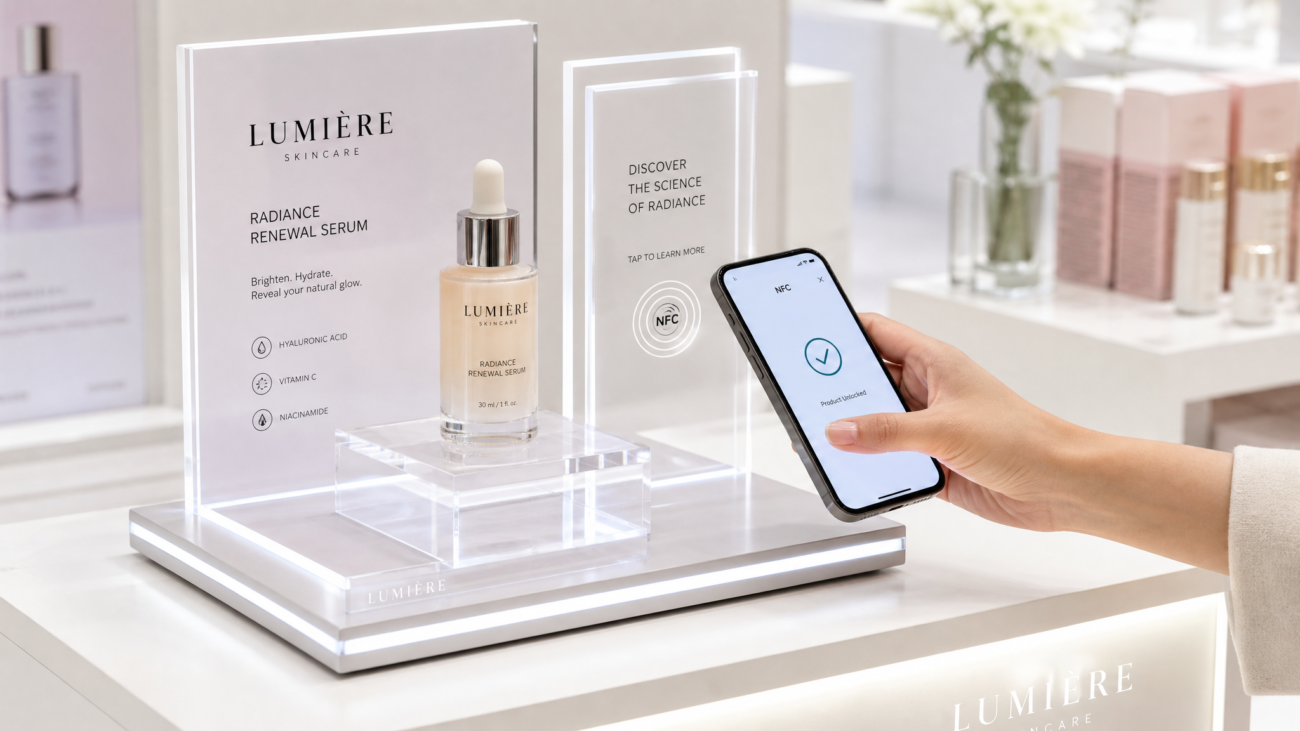
Transparent acrylic is the ideal carrier for edge-lit LED channels and near-field communication tags. In 2026, retailers are using lit acrylic displays to make premium beauty and digital products pop at shelf level. NFC-enabled acrylic merchandising displays let shoppers tap a panel to pull up reviews, shade finders, or warranty registration.
Industry audits show lit acrylic display products lift premium product attention by **22–35%** in controlled store tests. The technology is no longer exotic. Edge-lit LED strips, low-voltage drivers, and NFC tags add only a few dollars per unit at volume.
### What to request from your supplier
– **IP-rated LED channels** for easy replacement.
– A **low-voltage wiring plan** that passes store safety audits.
– **NFC tag placement** that does not obstruct the product.
– **Sample unit approval** before committing to 1,000+ pieces.
## Minimalist Transparent Merchandising Is Winning Beauty, Digital, and Exhibition Clients
The 2026 aesthetic is less material, more signal. Beauty retailers are replacing bulky branded pods with slim acrylic display risers that let the product be the hero. Consumer electronics and digital accessory brands use clear acrylic stands to keep cables, cases, and earbuds visible without visual noise.
Exhibition clients need lightweight, tool-free acrylic display products that assemble in minutes on a trade show floor. Cross-border sellers and brand owners face a specific tension. They want a premium retail look but often order smaller quantities and need fast turnaround.
A supplier that understands overseas market trends can recommend which acrylic display styles photograph well for Amazon, TikTok Shop, and Instagram without inflating MOQs. That cross-category pattern recognition is exactly what saves retailers from ordering displays that look dated in six months.
### Style directions to test in 2026
– **Floating product illusion** with transparent pedestals.
– **Frosted acrylic back panels** for logo contrast.
– **Rounded edges and thin profiles** for a softer premium feel.
– **Mixed clear and colored acrylic** for seasonal campaigns.
## Fast Sampling and Trend-Responsive Development Now Decide Supplier Selection
Speed is the silent margin killer in acrylic display sourcing. Retailers and cross-border sellers who wait **30–45 days** for a first sample miss the trend window entirely. 2026 acrylic display market trends reward suppliers that can turn a concept into a physical sample in **5–7 working days**.
Reliable manufacturers typically maintain a trend library of proven acrylic display product structures. They can suggest new product development directions — such as a detachable phone holder tray or a two-tier lipstick tester — before you ask. This is where working with a team that serves beauty, retail, digital, and exhibition clients pays off: the pattern recognition crosses categories.
### How to pressure-test a supplier’s development speed
– Ask for **sample lead time in writing** before payment.
– Request **three recent examples** of trend-responsive development.
– Confirm they support **small-batch fast sampling** before mass production.
– Check whether they understand **cross-border packaging and compliance**.
## The 2026 Acrylic Display Supplier Audit Checklist
Most chargebacks and rework costs come from suppliers who quote cheap but cut corners. To avoid costly chargebacks, audit your acrylic display supplier against these six checks before your next order.
### Six checks for every acrylic display order
1. **Material certification** — virgin or certified recycled acrylic, with documentation.
2. **Edge finishing** — flame-polished or diamond-polished edges, no sharp burrs.
3. **Thickness honesty** — verify stated panel thickness with calipers on arrival.
4. **Packaging spec** — corner protection and film masking to prevent transit scratches.
5. **Color consistency** — request a master panel for each tinted acrylic batch.
6. **Lead time clause** — a penalty or discount if samples or bulk orders ship late.
Suppliers that pass all six checks are rare. Suppliers that pass all six and still offer **5–7 day sampling** are the ones aligned with 2026 retail acrylic display market trends.
## Conclusion: 3 Takeaways and Your Next Move
The 2026 acrylic display market rewards speed, sustainability, and modularity. First, **sustainable rPET and mono-material acrylic** are becoming table stakes, not differentiators. Second, **modular and NFC-enabled displays** cut cost per change and lift conversion by double digits.
Third, **5–7 day sampling** separates trend-responsive suppliers from order-takers. Use this checklist to audit your current acrylic display supplier before your next reorder. If they fail more than two checks, request quotes from a development team that understands overseas market trends, cross-border sellers, and brand owners — and ask for a sample within 7 working days.
—
## 📚 Related Resources
– Acrylic display manufacturing process explained → /acrylic-display-manufacturing-process
– Beauty retail acrylic display ideas for cross-border sellers → /beauty-retail-acrylic-display-ideas
– Acrylic display MOQ and costing guide → /acrylic-display-moq-costing-guide
– NFC-enabled retail display solutions → /nfc-enabled-retail-displays
– Modular acrylic display systems buying checklist → /modular-acrylic-display-systems-checklist
—
## ❓ Frequently Asked Questions
**Q: Are acrylic displays still relevant in 2026 retail?**
**A:** Yes. Acrylic display products are gaining share because they are lightweight, shatter-resistant, and faster to produce than glass or metal. 2026 retail acrylic display market trends favor transparent, modular, and recyclable fixtures that support fast assortment rotation.
**Q: What is a realistic sample lead time for a custom acrylic display?**
**A:** Reliable manufacturers typically deliver a first physical sample in **5–7 working days**. Suppliers quoting 30–45 days will miss the trend window, so confirm sample lead time in writing before payment.
**Q: How can retailers verify recycled acrylic claims?**
**A:** Request **rPET or R-PMMA certification** from the resin supplier plus a material composition sheet showing exact recycled content percentages. A take-back or regrind program is another strong signal of a genuine sustainability commitment.
**Q: Do NFC-enabled acrylic displays require special maintenance?**
**A:** No. Low-voltage LED drivers and passive NFC tags add minimal maintenance. Specify **IP-rated LED channels** and a low-voltage wiring plan that passes store safety audits to keep service costs near zero.
**Q: What MOQ should cross-border sellers expect for custom acrylic displays?**
**A:** MOQs vary by supplier. Many development teams that serve cross-border sellers and brand owners now support **small-batch fast sampling** before mass production, letting you validate a trend-responsive design without locking in large inventory.